
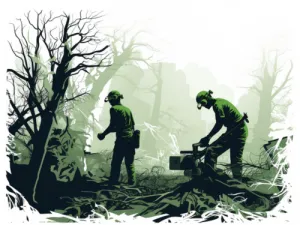

Illegal logging devastates biodiversity and accelerates climate change by destroying habitats, releasing stored carbon, and reducing forests’ ability to sequester CO2.
It also undermines economies, fuels corruption and displaces Indigenous communities. Combatting it requires strict enforcement, international cooperation, and sustainable forestry practices.
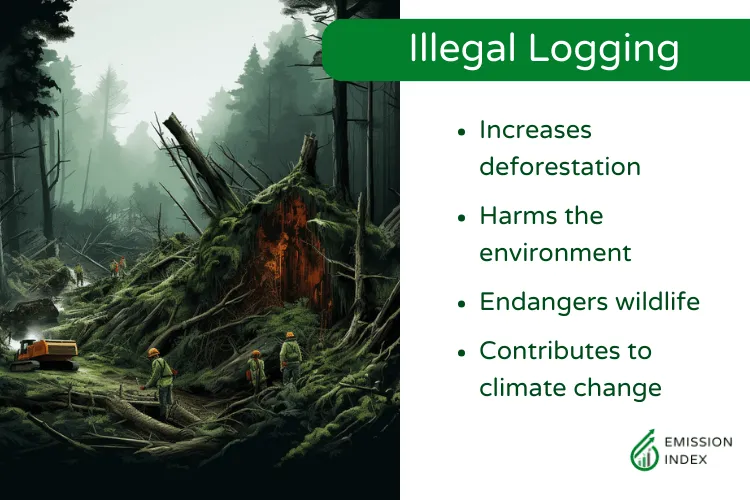
Illegal logging not only wipes out vast stretches of forest but also destabilises ecosystems, harms wildlife, and worsens global warming.
This article will explore:
- How illegal logging affects biodiversity and ecosystems.
- The role of legislation and international frameworks in combating it.
- Strategies to prevent illegal logging and mitigate its impacts.
Let’s get started!
Forests under threat: how illegal logging is destroying our ecosystems
Illegal logging is the harvesting of timber in violation of national laws. This practice plays a significant role in deforestation and profoundly impacts forests worldwide.
It contributes to the loss of trees and has cascading effects on the environment, disrupting fragile ecosystems and leading to biodiversity loss. These actions reach far beyond the immediate vicinity of forested areas, affecting climates and economies on a global scale.
Combatting illegal logging involves an intricate interplay of legislation, international frameworks, and coordination between governments and organisations.
As forests fall, so does their ability to support communities, regulate climate, and sustain wildlife.
Economic impacts are broad, with legal trade and national economies undermined by the unregulated market, threatening industries and livelihoods.
Social and governance issues arise as illegal activities may fuel corruption, conflict, and social unrest, especially among local and indigenous communities deeply connected to forest territories.
Legislation and international frameworks
Combatting illegal logging is like a game of chess played on multiple boards; strategy is key, and an intricate set of rules governs every move.
Hefty legislation and international treaties form these rules, aiming to align nations to protect global forests.
Lacey Act and U.S. policies
The Lacey Act represents one of the United States’ knight moves in the game against illegal logging. Passed in 1900, this legislation was initially crafted to combat illegal hunting, but it has since been amended to include wood products:
- Prohibits trade in wildlife, fish, and plants illegally taken, possessed, transported, or sold.
- Mandates that importers declare the country of origin and species of any wood products.
Compliance with the Lacey Act is crucial for companies importing wood into the United States; they must ensure their products are sourced legally.
EU timber regulation and FLEGT
The European Union (EU) constructed its own fortress against illegal logging with the EU Timber Regulation (EUTR) and Forest Law Enforcement, Governance and Trade (FLEGT):
- EUTR disallows the sale of illegally harvested timber and products within EU borders.
- FLEGT addresses the legality of imported timber through Voluntary Partnership Agreements (VPAs) with timber-exporting countries.
Both mechanisms stress due diligence and legally sourced timber in trade, reflecting the EU’s global commitment to sustainably managed forests.
Issues of forest law enforcement in developing countries
In developing countries, the establishment and enforcement of forest law can be seen at the grassroots level in the struggle against extensive logging:
- Many developing countries are working on strengthening governance and legal frameworks with international support.
- Developed countries and international bodies support implementing national laws to ensure compliance and sustainable forest management.
These international frameworks give developing countries the seeds to grow robust legal systems against illegal deforestation, fostering global environmental stewardship.
Environmental and ecological considerations
Illegal logging has severe environmental impacts, notably on biodiversity, climate change, and the health of global forests.
Biodiversity loss and species endangerment
Deforestation is a direct threat to wildlife. Habitats are destroyed, leaving species with nowhere to call home. For instance:
- Rainforests: Home to over half of the world’s terrestrial biodiversity, illegal logging operations here can lead to irreparable harm.
- Endangered animal species like tigers, primates, and certain birds are pushed closer to extinction.

Case study: impact on Birds in the Eastern Himalayas
A 2020 study of birds in the Eastern Himalayas (Srinivasan & Wilcove, 2020) found that survival trends are linked to species’ elevational ranges in primary forests but not in selectively logged forests.
The survival rates of birds in logged forests remained constant over time, indicating that illegal logging can significantly affect wildlife demographics.
Climate change and carbon emissions
Illegal logging aggravates climate change through the release of carbon:
- Carbon storage: Trees naturally sequester carbon, and their removal releases significant amounts into the atmosphere.
- Natural climate solutions: Intact forest cover is crucial for mitigating climate change, and their destruction means the loss of these vital functions.
Forest degradation and its global impact
The consequences of forest degradation extend far beyond local environments:
- Soil erosion: Without trees to anchor fertile soil, erosion occurs, leading to poorer land quality.
- Landslides: Stripped areas are more prone to landslides, which have devastating consequences for human settlements and agricultural land.
Economic impact
Illegal logging operations significantly affect economies, financially bleeding governments and lawful businesses.
It undermines legitimate trade, encouraging illicit markets that devalue the hard work of legal operators.
Revenue loss and tax evasion
Governments face substantial revenue losses due to illegal logging activities. These losses manifest in:
- Unpaid taxes
- Missed export duties
- Reduced income from legitimate forestry operations
This financial shortfall affects funding for essential public services and infrastructure development.
Contraband timber trade and black market
The black market for contraband timber flourishes in the shadows of the illegal logging trade. It includes:
- A complex network that enables money laundering
- The evasion of customs and trade regulations
Effect on legal timber and wood markets
The U.S. forest products industry and other legitimate markets suffer from unfair competition. Key points include:
- Lower international demand and market prices due to the saturation of the illegal timber industry
- Damage to the reputation of the industry, dissuading conscientious consumers

Social consequences and governance issues
Illegal loggers create ripples across societies, eroding the fabric of communities and governance structures.
Impacts on indigenous peoples and local communities
Illegal logging isn’t just the felling of trees and forest loss; it cuts deep into the lives of indigenous peoples and local communities.
Their dependence on forests for livelihood is overshadowed by the loss of biodiversity and cultural heritage. This destruction strips away their sustenance and the heart of their community bonds.
- Loss of livelihoods: Traditional occupations collapse as forests diminish.
- Human rights abuses: Confrontations over land rights often escalate.
Corruption and weak enforcement
The links between illegal logging and corruption can be as entangled as the roots of a forest.
In countries where governance is shaky, illegal cutting thrives, often lubricated by bribes and the complicity of officials.
- Governance and trade: Illegal timber trade undermines legal businesses.
- Rule of law: Weak legal frameworks invite further exploitation of forests.
Role of NGOs and civil society
NGOs and civil society organisations stand like watchtowers against the onslaught of illegal logging.
- Advocacy for stronger enforcement: They push for robust legal structures.
- Defence of human rights and environmental standards: They spotlight injustices caused by illegal logging activities.
Their involvement often tips the scales toward sustainable practices and better protection of forests and those who depend on them.
Geographical hotspots
Illegal logging operates much like a termite infestation in the structural integrity of forests, stealthily but surely causing degradation.
This section navigates through the areas most afflicted by this pervasive issue.
Southeast Asia and Pacific destruction
Countries such as Indonesia and Cambodia become prime targets for illegal logging due to their rich tropical forests and sometimes lax enforcement of forestry laws.
In Indonesia alone, the rainforest—akin to an emerald treasure chest of biodiversity—faces persistent threats from illicit activities.
Central Africa’s rainforests and conflicts
Central Africa boasts vast expanses of rainforest second only to the Amazon, yet these areas are mired in strife, where illicit logging not only strips the land but also fuels local conflicts.
The sound of chainsaws often silences the lush canopies that once echoed with the calls of wild creatures.
Amazon and South American challenges
The Amazon, sprawling across countries like Brazil and Peru, experiences some of the most severe impacts of illegal logging.
Tropical deforestation not only displaces indigenous communities but also disrupts the rainforest’s ability to function as a global climate regulator. The tree-felling spree here signals a dire alarm for environmental stability.
Supply chain accountability and transparency
Effective management in the supply chain ensures that timber commodities are legally sourced and responsibly transported.
Transport and logistics of illegally harvested timber
Transport pathways of illegally harvested wood are often complex and obscured. In tackling this, logistics companies and enforcement agencies aim to create a traceable trail from forest to market.
Technology enables better monitoring, while cooperation with local authorities ensures compliance with legal frameworks. For example, high-throughput sequencing can contribute to identifying tree species and combating illegal logging activities (Mascarello et al., 2021).
- Technology: GPS tracking, electronic logging
- Cooperation: Local law enforcement, International partnerships
Due diligence and certification systems
For suppliers, due diligence is a robust process of verifying the legality and ethical standards of their timber products.
Verification methods include:
- Audits: Independent checks on supplier practices
- Documentation: Proof of legal harvesting and ethical practices
Certification systems like FSC (Forest Stewardship Council) ensure that products come from responsibly managed forests.
Such certifications are vital in assuring consumers and stakeholders of the timber’s legal and sustainable origins.
Public and private sector cooperation
A strategic alliance between the public and private sectors is crucial for deepening the impact of anti-illegal logging measures.
Governments can enact policies to foster sustainable timber trade, and businesses can adopt these policies within their operations for a cleaner commodity market.
Actions taken include:
- Regulatory measures: Legal frameworks encouraging transparent trade
- Partnerships: Between governments and corporations for better forest governance
In encompassing supply chain dynamics, strengthening transparency is evident at each stage, from due diligence efforts to multi-stakeholder collaborations.
Prevention and remediation strategies
Taking a leaf from the vigilant gardener who protects his green haven, the global strategy to tackle unsustainable logging requires robust actions that nip the problem in the bud.
This crafted approach combines stringent law enforcement, technological oversight, the nurturing of protected environmental sanctuaries, and the fostering of community participation.
Law enforcement and monitoring technologies
Forest law enforcement plays a key role in preventing illegal logging by deterring offenders through penalties.
This is often coupled with advanced monitoring technologies such as satellite imagery and drones, which act like watchful eyes in the sky to track deforestation activities.
Governments and organisations use these tools for:
- Real-time surveillance of forested regions
- Quick response to illegal activities
The World Bank has supported initiatives integrating technology and governance to strengthen forest law enforcement.
Protected areas and forestry conservation efforts
Legally established protected areas serve as inviolable sanctuaries for the world’s forests.
Within these areas, stringent regulations are in place to ensure the integrity of the ecosystems.
Efforts in conservation can include:
- Establishing new protected areas
- Expanding or connecting existing ones via ecological corridors
Groups like the Forest Stewardship Council (FSC) promote responsible land use and forest management practices that help maintain these critical areas.
Community engagement and sustainable development
The support and involvement of local communities are paramount for the success of any conservation effort.
They act as the grassroots stewards of the forest, and their engagement leads to sustainable development.
Initiatives for community engagement involve:
- Education and awareness programs
- Sustainable livelihood opportunities
Governance involving community voices in decision-making processes propels the move toward sustainable land use and forest preservation.
Frequently asked questions
Trees naturally absorb carbon dioxide, so their removal through illegal forest exploitation exacerbates climate change by reducing the number of trees available to sequester carbon.
Various international agreements, like those monitored by U.S. Customs and Border Protection, aim to curb illegal logging and conserve forests by implementing strict trade laws and collaboration between nations.
Lawful forestry follows regulations that balance harvesting with conservation, while illegal logging ignores such rules, often causing irreversible environmental damage.