


Deforestation disrupts the phosphorus cycle by increasing soil erosion and runoff, which depletes phosphorus-rich soil. This reduces phosphorus availability for plants and leads to excess phosphorus in water bodies, causing eutrophication.
These changes can hinder forest regrowth, harm biodiversity, and alter terrestrial and aquatic ecosystem dynamics.
The effects can be immediate and long-lasting, hindering vegetation regrowth and causing nutrient imbalances in water systems.
This article will cover:
- How does deforestation disrupt phosphorus availability in soil and water systems?
- What are the long-term impacts on biodiversity and ecosystem health?
- What strategies can help mitigate the negative effects of deforestation on the phosphorus cycle?
Let’s get into it!
Understanding phosphorus cycling
The phosphorus cycle is integral to ecosystems, reflecting its journey from rocks to every living cell and revealing its essential role in growth and decay.
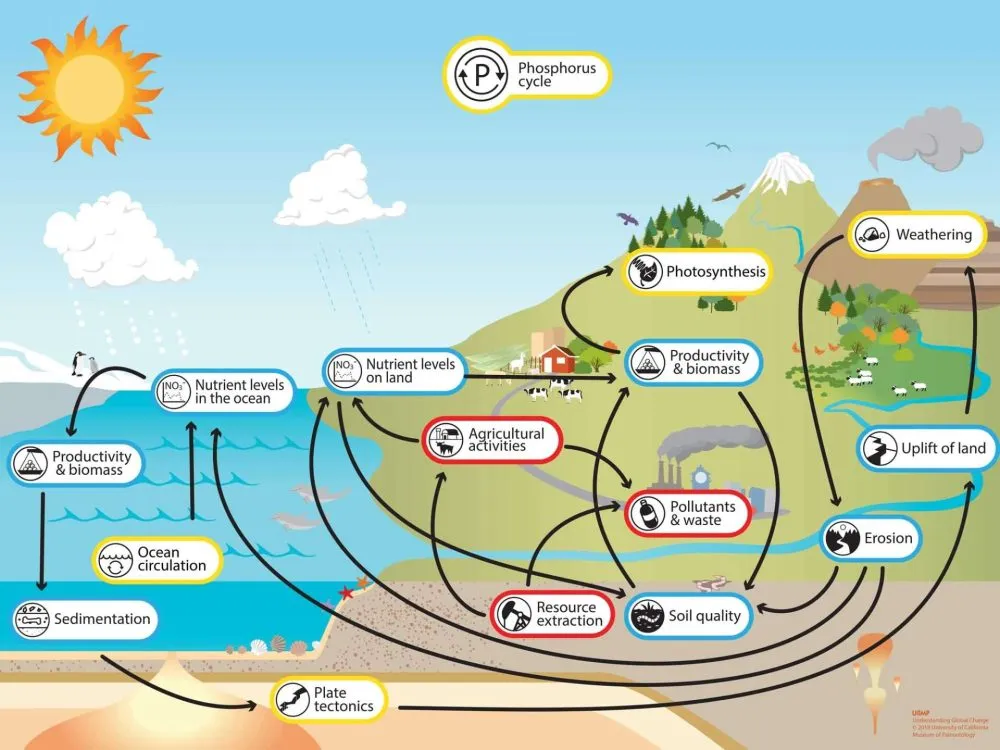
Phosphorus in the environment
Phosphorus, a building block for all living organisms, begins in the lithosphere – the Earth’s crust – primarily locked within rocks. Weathering processes release phosphate ions into the soil and water systems.
- Rocks: Phosphate is mainly found in sedimentary rocks
- Soil: An essential nutrient for plant growth
- Water: Carries dissolved phosphate ions
Phosphorus movement through ecosystems
This nutrient’s journey through the biosphere is complex yet critical for life’s tapestry. From the smallest microorganisms to the largest animals, phosphorus is passed through consumption and decomposition.
- Organisms: Use phosphorus for cell function and growth
- Decomposition: Returns phosphorus to soil and water
- Movement:
- From Soil to Plants: Absorbed by roots
- From Plants to Animals: Via the food chain
- Back to the Environment: Through excretion and decay
Human impact
Human activities, including farming and deforestation, have altered the natural flow of phosphorus. These actions intensify soil erosion and can catalyse the release of phosphorus into the atmosphere as dust.
- Agriculture: Increases phosphorus through fertilisation
- Deforestation: Leads to soil loss and affects soil phosphorus stock
- Erosion and Dust: Transport phosphorus from land to oceans
Deforestation and its impacts
Deforestation acts much like an unplanned urban development on a once-quaint countryside, harshly altering the landscape’s function and beauty.
Effects on soil and water
Deforestation strips the land like a harsh wind strips leaves from trees. This stripping:
- Disrupts soil stability: It removes trees that anchor fertile soil.
- Increases surface runoff: Water that is usually absorbed runs off, leading to erosion.
- Sedimentation in rivers: The runoff carries sediments that can clog rivers, affecting water quality and aquatic life.
Altering the phosphorus availability
Like a carefully balanced recipe gone awry, deforestation disrupts the nutrient mix in the soil surface by:
- Leaching vital nutrients: Without trees, the soil is more exposed to rain, which leaches phosphorus.
- Changing soil chemistry: The absence of leaf litter alters the soil’s phosphorus content.
Implications for ecosystems and biodiversity
Deforestation’s ripple effect touches every corner of an ecosystem:
- Eutrophication: Increased phosphorus in water bodies leads to algae growth, depleting oxygen for other organisms.
- Aquatic ecosystems: Sediment and nutrient changes stress marine life, leading to biodiversity loss in lakes and rivers.
- Terrestrial effects: Land-based ecosystems suffer as nutrient cycles are disrupted, impacting plant and animal life dependent on that delicate balance.
Research papers highlighting the effects
Cutting down forests can make it harder for plants to get the phosphorus they need, change how rivers flow and what’s in them, and make it difficult for new forests to grow. This can hurt the health of the environment and all the plants and animals that live there.
Key findings from relevant research papers are summarised below:
- More phosphorus in oceans and lakes: When trees are cut down, more phosphorus (a vital nutrient) ends up in rivers and oceans. This is because of increased fertiliser use, soil washing away, and waste from towns and cities. This extra phosphorus can make lakes and coastal areas too rich in nutrients, causing problems like excessive algae growth (Filippelli, 2008).
- Impact on microbial populations and phosphorus availability: Trees help maintain tiny organisms in the soil that are important for keeping phosphorus available for plants. When forests are cut down, these organisms decrease, leading to less phosphorus in the soil. This is an issue because once phosphorus is gone from the soil, it takes a long time to return naturally (Runyan & D’Odorico, 2013).
- Changes in soil and rivers: In places like Costa Rica, cutting down forests changes the soil and river flow. The soil loses more than a third of its phosphorus, and rivers flow faster and more strongly in the rainy season. This also leads to more nitrogen and phosphorus getting washed into rivers (Bringhurst & Jordan, 2015).
- Less carbon storage and changes in emissions: Cutting down forests also affects how much carbon dioxide (a greenhouse gas) is taken up or released by the land. Land-use changes, including deforestation, change the balance of carbon and nutrients, affecting the growth of plants and the health of the environment (Wang et al., 2015).
- Harder for forests to grow back: Repeated deforestation, especially in areas where phosphorus is already limited, reduces the capacity of new trees and plants to grow back. The soil loses its phosphorus, leading to areas where very few plants can grow (Runyan, D’Odorico, & Lawrence, 2012).
Role of phosphorus in living organisms
Phosphorus is the cornerstone of vitality, underpinning living organisms’ growth and metabolic processes. It’s pivotal in the seamless triad of life’s construction, energy, and communication.
Phosphorus and biological growth
Phosphate, typically found as calcium phosphate in bone and teeth, plays a crucial role in lending rigidity and structural integrity to the skeletons of animals and the cell walls of plants. Organisms ranging from towering trees to the tiniest algae rely on phosphate for:
- Cell division and growth: Phosphate is vital for producing nucleic acids and ATP, molecules central to life’s energy flow.
- Formation of biomass: Every creature, whether a giant whale or a minuscule microbe, uses phosphate to create and maintain its biomass.
The cycle of phosphorus in organisms
Within organisms, the movement of phosphorus is a delicate dance, essential for life but perilous if misstep. Phosphorus cycles through various forms:
- Nucleotides and nucleic acids: DNA and RNA threads, the blueprint of life, comprise phosphate nucleotide sequences.
- Cell membranes and phospholipids: Organisms protect their inner workings with a barrier built from phospholipids, with phosphate groups ensuring stability.
- Plant growth efficiency: Algae and fungi, agents of primary production, harness phosphate as an essential nutrient to convert sunlight and carbon into life-sustaining organic compounds.
By threading the needle between growth and decay, phosphorus cycling tightly weaves into the larger tapestry of life, encompassing biological, geological, and chemical cycles.
Effects of deforestation on aquatic systems
When trees are felled, the availability of nutrients like phosphorus and nitrogen in nearby water bodies can be disrupted. This alteration has profound impacts on aquatic ecosystems.
Nutrient loading and eutrophication
- Leaching and runoff: When forests are cleared, rainfall washes phosphorus-rich soil into streams and lakes.
- Accelerated Eutrophication: Excess nutrients, particularly phosphorus, in bodies of water lead to algal blooms. Algal blooms can create ‘dead zones’ where dissolved oxygen is depleted, severely affecting aquatic life.
Water quality and aquatic life
- Impact on Fish and Aquatic Species: Fish and other aquatic species suffer as water quality declines and dissolved oxygen levels fall.
- Nutrient Imbalance: Elevated phosphorus in water disrupts the nitrogen cycle, modifying the nutrient availability for aquatic organisms.
- Sediment Increase: Deforestation increases sediment in water, which can suffocate fish eggs and reduce light availability, affecting photosynthesis in aquatic plants.
Mitigating the adverse effects
To maintain the balance of the global phosphorus cycle, specific solutions to deforestation need to be considered.
These strategies are essential in mitigating deforestation’s detrimental effects on soil health and nutrient cycles.
Restoration and reforestation strategies
Effective rehabilitation begins with restoration and reforestation strategies prioritising the reinstatement of indigenous vegetation. They focus on:
- Native species planting: Ensuring the return of local flora that is well-adapted to the region’s phosphorus cycle.
- Diversification: Combining tree planting with conservation agriculture to bolster phosphorus uptake from the soil.
Through these methods, soil regeneration is supported, helping to restore the disrupted phosphorus cycle.
Sustainable land use policies
Sustainable land use policies are pivotal in preventing further phosphorus cycle disruption. They encompass:
- Soil conservation techniques: Implementing terracing, contour ploughing, and cover cropping to reduce runoff and soil erosion.
- Regulation of fertiliser use: Encouraging the application of fertilisers in a manner that minimises excess phosphorus leaching into water systems.
- Policy enforcement: Ensuring land management practices adhere to guidelines that protect and maintain soil quality.
These measures aim to create a balance where agriculture thrives without compromising the integrity of the phosphorus cycle. Through them, the health of the soil and surrounding ecosystems can be protected, sustaining both the environment and agricultural productivity.
Frequently asked questions
Human activities, including agriculture and sewage disposal, introduce additional phosphorus to ecosystems. This can lead to excess phosphorus in water bodies, causing eutrophication. Conversely, deforestation decreases the soil’s phosphorus, disrupting the cycle.
Land-use change impacts phosphorus availability by:
- Reducing leaf litter, which replenishes soil phosphorus.
- Increasing soil erosion which leads to phosphorus loss.
Deforestation primarily affects the carbon cycle by releasing stored carbon dioxide. However, it also significantly disrupts the phosphorus cycle as biomass removal and soil erosion alter phosphorus storage and flow.
- The phosphorus cycle does not involve the atmosphere; it mainly moves through rocks, water, and living organisms. Deforestation reduces phosphorus in the soil.
- The nitrogen cycle involves atmospheric nitrogen. Deforestation affects this cycle by reducing nitrogen-fixing plants, which can lead to a decrease in available nitrogen.